Day: 25 August 2011

  • ABC Circulations Jan June 2011

    The ABC Circulations for Jan June 2011 were released and make for fairly sobering reading. The circulation of National newspapers papers in the Republic of Ireland has declined by over 165,000 in twelve months. The biggest faller was in the Sunday market where there have been two newspaper closures in the year. Even stripping out those two titles, like for like sales of the remaining titles is still down 5%.

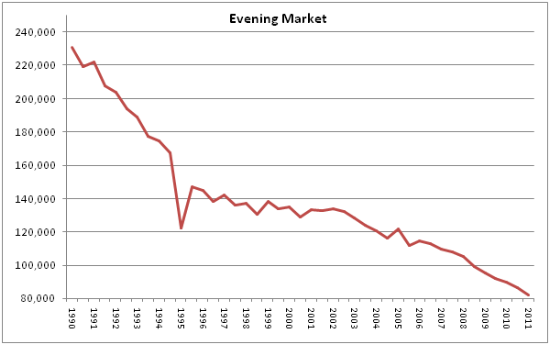
    Mornings are dwon 5% and the evening market continues its near two decade decline.

    Market JJ 2011 JJ 2010 Diff ‘000 Diff %
    Total Sunday 993,598 1,120,808 -127,210 -11%
    Total Morning 575,008 605,354 -30,346 -5%
    Total Evening 81,947 89,945 -7,998 -9%
    Total Market 1,650,553 1,816,107 -165,554 -9%

    You can get a closer look at each market here: Sunday, Morning, Evening. The Regional will follow shortly

  • Irish Sunday Newspaper Circulation Jan June 2011

    Irish Sunday Newspaper Circulation Jan June 2011

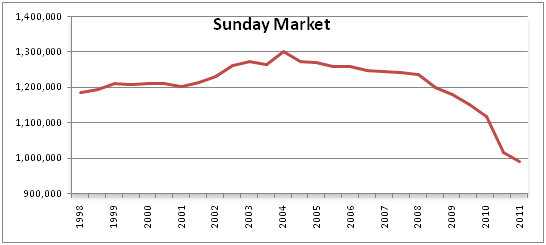
    If you wnated a headlin figure for this Jan June 2011 ABC’s it would be the fact that the Sunday market slipped into six figures. It comes on the back of  the closure of the Sunday Tribune and the semi-closure (as the paper in another guise is still available) of the Daily Star on Sunday.  

    Actually it could be worse as the News of the World in real life is no longer around but still reported figures for those six months. But even with their final contribution the market is down 127,000 or 11%.  


    Publication JJ 2011 JJ 2010 Diff ‘000 Diff %
    Sunday Independent 255,806 265,455 -9,649 -4%
    Sunday World 246,875 267,130 -20,255 -8%
    Sunday Tribune 0 54,400 -54,400
    Sunday Business Post 47,849 49,637 -1,788 -4%
    Daily Star Sunday 28,458 54,224 -25,766 -48%
    Irish News of the World 115,577 131,410 -15,833 -12%
    Irish Sunday Mirror 40,785 37,252 3,533 9%
    The People 18,848 20,303 -1,455 -7%
    Sunday Express 4,077 3,949 128 3%
    IoS/Daily Mail 113,160 112,897 263 0%
    Independent on Sunday 1,349 1,639 -290 -18%
    The Observer 7,362 8,169 -807 -10%
    Sunday Telegraph 2,760 2,451 309 13%
    Sunday Times 110,692 111,892 -1,200 -1%
    Total Sunday 993,598 1,120,808 -127,210 -11%

    The Sunday Independent managed only a ‘modest’ 4% decline but is still in top slot as the largest biggest selling newspaper.

    This accolade was greatly helped by the Sunday World loosing over 20,000 sales or 8% year on year.

    Regretfully, not all of the papers subscribe to monthly ABC reporting so it’s impossible to see what the effect of the closure of the News of the World had on the sales of the Sunday World.

    The Sunday Mirror had a decent first half in comparison to the previous year managing a 9% increase year on year. What we do know is that the Mirror was a benefactor of the NoW’s demise posting an ABC of 66,980 for July 2011 in comparison to 41,000 here (see what monthly reporting can do!).

    The Mail on Sunday also stayed the right side of the redline and the Sunday Times was down only 1%.

    The Graphs below neatly summarise the Sunday market. The first is the total market figure form 1998. The second indexes the different market segments; Tabloid, Non-Tabloid* and Total Market back to 1998. You can see clearly that the non-tabloids feasted off the Celtic Tiger in the Sunday market. 

    Sunday

    Sunday index

    *Non-tabloid: it’s such a tragic way to group papers! Some of the papers in the ‘non’ group are actually tabloids as the word describes it a newspaper measurement or dimension. However, the term was hijacked by the media and is now used to describe a particular genre of paper.

  • Irish Daily Newspaper Circulation Jan June 2011

    The morning market declined by 5% year on year in 2011 (not too bad in comparison to the 11% fall in the Sunday Market) and sees it drop below the 600,000 mark. Just to ram home the recessionary point, the morning market hasn’t seen an increase in sales since 2007.

    Publication JJ 2011 JJ 2010 Diff ‘000 Diff %
    Irish Independent 134,228 144,896 -10,668 -7%
    Irish Times 100,951 105,742 -4,791 -5%
    Examiner 43,390 46,687 -3,297 -7%
    Daily Mirror 61,998 60,418 1,580 3%
    Irish Daily Star 87,121 93,630 -6,509 -7%
    The Sun 79,893 86,453 -6,560 -8%
             
    Daily Express 2,960 2,966 -6 0%
    Irish Daily Mail 51,072 50,515 557 1%
             
    Daily Telegraph 2,934 2,872 62 2%
    Financial Times 3,539 3,653 -114 -3%
    Guardian 3,700 3,818 -118 -3%
    i 554      
    The Independent 960 1,143 -183 -16%
    The Times 2,262 2,561 -299 -12%
             
    Total 575,562 605,354 -30,346 -5%

    The Irish Times just managed to stay above the 100,000 mark. The paper joined that particular club way back in 1996 and it’s a trophy that it would be very reluctant to give up. So much so that the surgeons in the paper’s circulation department are applying (very legitimate) cosmetic surgery in order that the paper preserves its looks.

    The Botox in this case comes in the form of ‘bulks’, a procedure that many of the papers indulge in. In the I.T’s case bulks makes up about 6% of the total ‘sale’. The Irish Independent is receiving the very same treatment, but its dosage is in double figures, with bulks currently making up some 12% of its figure.

    The Irish Independent was the biggest faller (in copy sales terms anyway) declining by 10,600 copies in 12 months. Stripping out the bulks, the tangle between the compact and broadsheet is working out at roughly 70/30 in favour of the compact.

    Full rate sales of the I.I. are about 118,000 copies a day of which about 36,000 are broadsheet. The question in this economic climate would be: how die-hard and loyal to the broadsheet format is that body of 40,000 purchasers?

    If the broadsheet wasn’t available would they choose the compact? Talbot Street is running parallel production every night for the Independent. It’s not quite replication as it’s only at the prepress stage the duel production is seen.

    Would the potential savings of running a compact only edition be worth the risk of “offending” the 40k broadsheet purchasers? I’m sure their bean counters have the costs of the parallel production at the ready, but who knows the how the masses would vote in the absence of their beloved broadsheet.

    The tabloids fared badly in the 12 months. The Sun is back 8% to 79,000 copies and The Star down 7% to 87,000. The Daily Mirror, like its sister Sunday, is the only paper to buck the trend and is up 3% on the year. Likewise the Daily Mail managed to add 1% to its figure (with about a 4% surgical solution!)

    The other papers in the market only make up 3% of the overall.

    The two graphs show vividly the rise and fall of the morning market. The first is copy sales from 1998 and the second is the market indexed to 1998. Interestingly in the morning market that the tabloids were by far the winners during the boom whereas in the Sunday market the tabloids didn’t experience the same kick.

    At their height the tabloids were selling 306,000 copies every morning compared to the 230,000 they sell daily currently.

    And, just to make the point about the lightening speed of some of the print media:  
     

  • Irish Evening Newspaper Circulation Jan June 2011

    Irish Evening Newspaper Circulation Jan June 2011

    Just to be complete the Evening Market. There is no daily breakdown of the Heralds’ figure, so it’s impossible to say how the addition of the Dubliner has worked for them.  


    Publication JJ 2011 JJ 2010 Diff ‘000 Diff %
    Evening Herald 61,936 67,657 -5,721 -8%
    Echo 20,011 22,288 -2,277 -10%
    Total 81,947 89,945 -7,998 -9%

    There is very little else to add, bar in graphical form, which really says it all.   

    evening